
Film type · Substrat-Spoke
Acetate diacetate (CDA) / triacetate (CTA).
Cast cellulose acetate film, crystal clear and matte, some types certified compostable in industrial and home composting.
Overview
What is Acetate?
Acetate films are highly transparent, glossy and flexible films made from cellulose acetate, a polymer derived from natural raw materials such as cellulose, cotton or wood.
The main difference between diacetate and triacetate films lies in the degree of acetylation (the proportion of acetic acid groups chemically bound to the cellulose), the solvent used in production and the resulting mechanical and thermal properties.
Diacetate is used mainly in printing and lamination applications, as adhesive tape, as windows in carton packaging, for labels, in optical applications and as an abrasion-resistant surface.
Triacetate is found in LCD displays, in the photo and film industry, as well as in optical and technical applications and in the medical sector.
Technical valuesProperties
Eigenschaften von Acetate.
PlatzhalterInput Vertrieb
Worauf kommt es bei Acetate in der Praxis an? Bitte im Review dieser Seite stichpunktartig notieren. Daraus entsteht der Text für diesen Abschnitt. Zahlenwerte stehen nur in der Tabelle darunter.
Technical data
Technical values, from–to.
| Property | Value | Unit |
|---|---|---|
| Density | 1.31–1.32 | g/cm³ |
| Tensile strength | 80–110 | MPa |
| Glass transition temperature | 92–120 | °C |
| Dielectric strength | 15 | kV/mm |
| Shrinkage | 0.1–1.5 | % |
| Thickness range | 20–500 | µm |
The values are ranges across all types. We select the right type for your application together with you.
We are happy to provide product-specific technical data for particular film types on request.
Variants
Acetate variants: a selection from the portfolio.
Diacetate (CDA)
| Type | Group | Character |
|---|---|---|
| T17 Gloss | graphic, glossy | Glossy on both sides, thin grades. |
| T17 Matt | graphic, matte on one side | One side matte with a very low gloss value, one side glossy. |
| T24 Clear | graphic, thick | Clear range in thick grades. |
| CFM45 | sealable | Heat-sealable; seals to itself, cellulose acetate, foil, molded fiber, PET and PLA; also ultrasonic and RF welding. |
| Sunglass and LCD types | optical | Specialty types with very low haze or a defined UV cutoff. |
Triacetate (CTA)
| Type | Group | Character |
|---|---|---|
| CTA clear | technical, clear | Cast films for technical applications, colorless, high light transmission, low haze, 50–240 µm. |
| CTA RM | technical, matte on one side | Heavily matte on one side, tinted blue, 30–180 µm. |
| CTA CM | technical, matte on one side | Heavily matte on one side, colorless, 30–180 µm. |
| Sunglass and LCD types | optical | Specialty types with very low haze, defined UV coverage (including UV400, UV380), clear or tinted, 80–240 µm. |
Industries in which Acetate is typically used
Use by industry.

Automotive Industry
View industry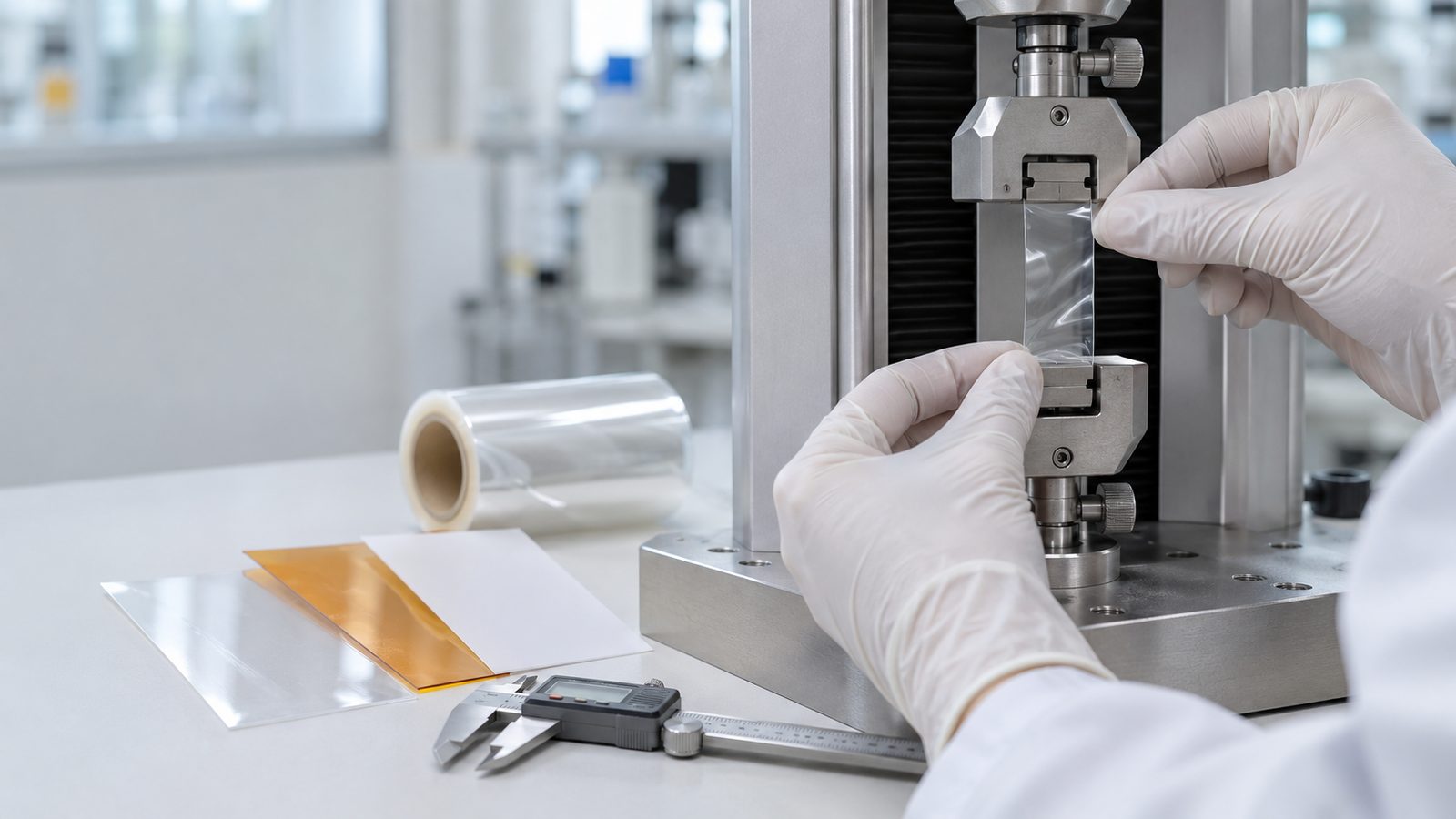
Public Sector, Education and Research
View industry
Electrical and Electronics Industry
View industry
Machinery and Plant Engineering
View industry
Furniture Industry and Interior Fit-Out
View industry
Paper, Paperboard and Board Industry Including Finishing
View industry
Printing and Media Industry Including Print Finishing
View industry
Packaging Industry
View industry
Textile, Apparel and Leather Industry
View industry
Aerospace Industry
View industryDenkbar, im Einzelfall zu prüfen
Chemische Industrie und Kunststoffindustrie · Energieversorgung und Umweltwirtschaft · Lebensmittel- und Getränkeindustrie · Kosmetik- und Körperpflegeindustrie · Sportartikel- und Spielwarenindustrie · Verteidigungs- und Sicherheitsindustrie
Für diese Branchen ist Acetate aus verwandten Anwendungen abgeleitet und nicht aus einer bestehenden Zuordnung übernommen. Ob das Substrat zu Ihrer konkreten Anwendung passt, klären wir vor einer Zusage. So beschreibt es die Pütz-Methode.
Converting at Pütz
Converting at Pütz.
You receive acetate films as rolls, as sheets and cut-to-size sheets or as traverse-wound spools. For your own material, we take care of toll converting.
Two requirements from the manufacturer documentation matter in practice with acetate: storage should be indoors, within a moderate temperature range and without condensation. The warranty is limited in time from the factory. The material absorbs moisture, so climate control is not a side issue.
Sustainability
Compostable – even in the garden compost.
Diacetate film is compostable and biodegradable because it is made from renewable wood-fiber cellulose. However, film thickness is decisive for the decomposition time: films up to just over 100 µm decompose in home compost within a few weeks.
Thicker diacetate films tend to require industrial composting, because these processes provide the conditions for timely decomposition of the film (including temperature, moisture and microbes). Some film types are certified to EN 13432 by DIN CERTCO and to ASTM D6400 by BPI for industrial composting, and to OK Home Compost for home composting.
Triacetate films are not fully compostable and are not intended for this type of end-of-life treatment.
Consulting
Consulting according to the Pütz Method.
We are happy to work out together with you which acetate film suits your application, following the Pütz Method.
It starts with clarifying your requirements, not with a product suggestion. The Pütz Method describes the process in nine steps.
Inquire directly
Your inquiry about Acetate.
You receive Acetate converted, finished and slit to your requirements: converting, finishing and toll converting.
Prefer to talk directly? Your contacts:

Juan Gomez
Sales & Project Management
T+49 6128 964-330 M+49 151 14964300 @juan.gomez@puetz-folien.com
Michael Büttner
Sales & Project Management
T+49 6128 964-315 M+49 160 8964315 @michael.buettner@puetz-folien.com
Kevin Winkelmann
Sales & Project Management
T+49 6128 964-305 M+49 176 11964305 @kevin.winkelmann@puetz-folien.comDisclaimer: The technical data, properties and areas of application stated on this page are based on information from our suppliers and on typical empirical values. They do not constitute guaranteed specifications. Production-related deviations, further developments or changes to product properties are possible at any time. Whether a film type is actually suitable for a specific purpose must be verified on a case-by-case basis. That is exactly what the Pütz Method is for: together we clarify the requirements and provide samples for your own tests. Before placing an order, please explicitly ask us about availability and current specifications. All information is provided without guarantee.
Frequently asked questions
Good to know.
What is acetate film?
Acetate films are highly transparent, glossy and flexible films made from cellulose acetate, a polymer derived from natural raw materials such as cellulose, cotton or wood.
What is the difference between CTA and CDA?
The main difference between CDA (cellulose diacetate) and CTA (cellulose triacetate) lies in their chemical degree of esterification (degree of substitution) and the resulting physical properties such as heat resistance, solubility and dimensional stability.
Is acetate film compostable?
Some of the types are – with triple certification: to EN 13432 for industrial composting, to ASTM D6400, and to OK Home Compost for home composting. However, the certification applies per type and thickness; for the thick range, only to a single grade.
How much heat can acetate films withstand?
Triacetate can generally be used up to approx. 100 to 110 °C in the standard range and begins to soften above that. The material remains stable between −10 and +100 °C. The heat resistance of diacetate is somewhat lower.
In which thicknesses are acetate films available?
Depending on the manufacturer, the thicknesses offered range from 20 to 500 µm. We are happy to clarify in detail with you which thickness may be decisive for your application.
Is matte acetate film available?
Yes, in two versions: matte on one side for the graphic ranges with a very low gloss value, and matte-cast technical types whose texture comes directly from the casting belt.